All-on-6 dental implants in Costa Rica
Teeth that stay in place, anchored on six implants per arch. Most cases take two trips, and you never leave the clinic without teeth.
What All-on-6 is
All-on-6 replaces a full arch with a fixed bridge anchored on six implants. Unlike a denture, it stays put: you eat, speak and smile with teeth that do not move.
The bridge here is solid zirconia, milled in the clinic’s own laboratory. Cheap full-arch work, in Costa Rica and the United States alike, is usually an acrylic hybrid, which wears and stains far faster — the usual reason two quotes for "the same" treatment sit thousands apart.
The implants are Ritter, made in Germany and cleared by the U.S. FDA. Brand matters years later, not on the day: parts for an established system are still made when one needs replacing. Unbranded implants cannot promise that.
Six implants spread chewing force across the arch, which can improve stability and help preserve bone. Whether six is right for you, or four, depends on your bone volume and bite, confirmed with a CBCT scan.
Why patients travel to Costa Rica for it
Full-arch implant work is among the most technique-sensitive procedures in dentistry, and among the most expensive in the United States. Here the planning, the surgery and the final bridge happen in one building, at savings of up to 60% against typical U.S. fees.
The savings matter, but they are not how you choose a surgeon. Choose the doctor first: training, case volume, and how clearly the plan is explained before you commit.
How six implants carry a fixed arch
A 3D animation, not a patient: it shows where the six implants sit and how the bridge fixes onto them. Your own plan is confirmed with a CBCT scan, and whether six implants is right for you, or four, depends on your bone and bite.
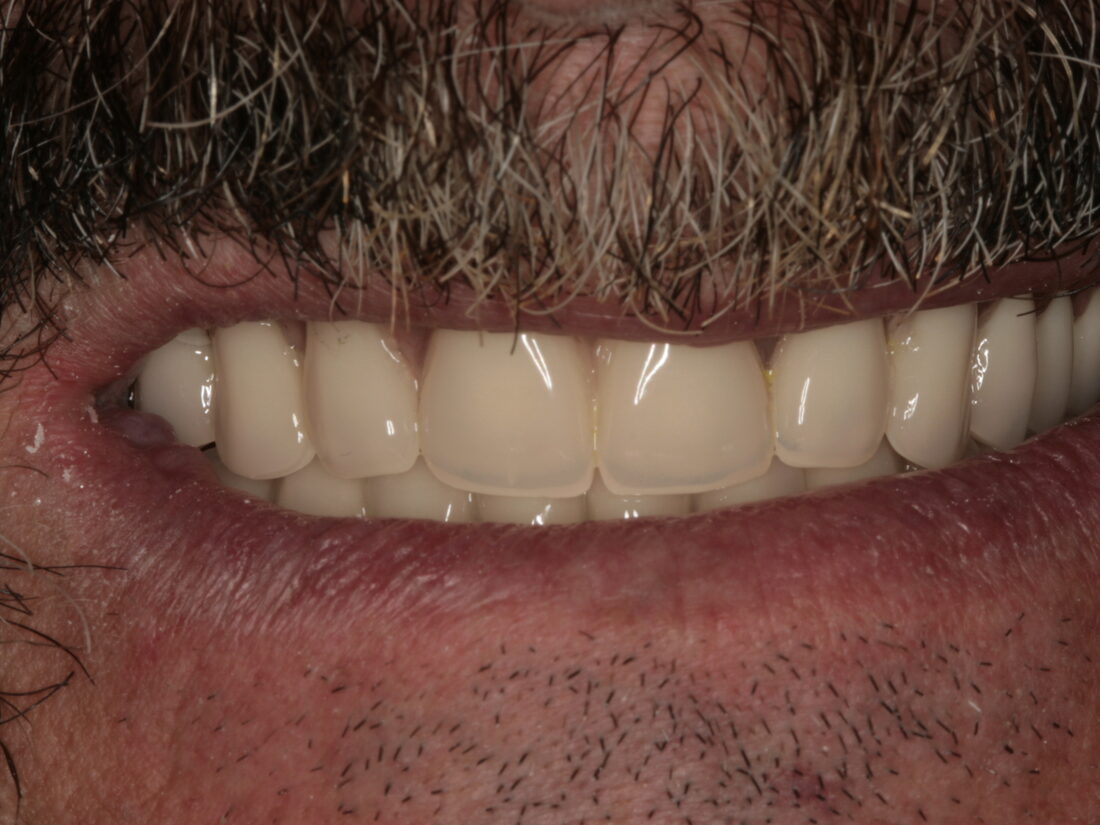 BeforeAfterClose-up of a patient’s mouth before treatment, showing a few remaining broken and decayed upper teeth.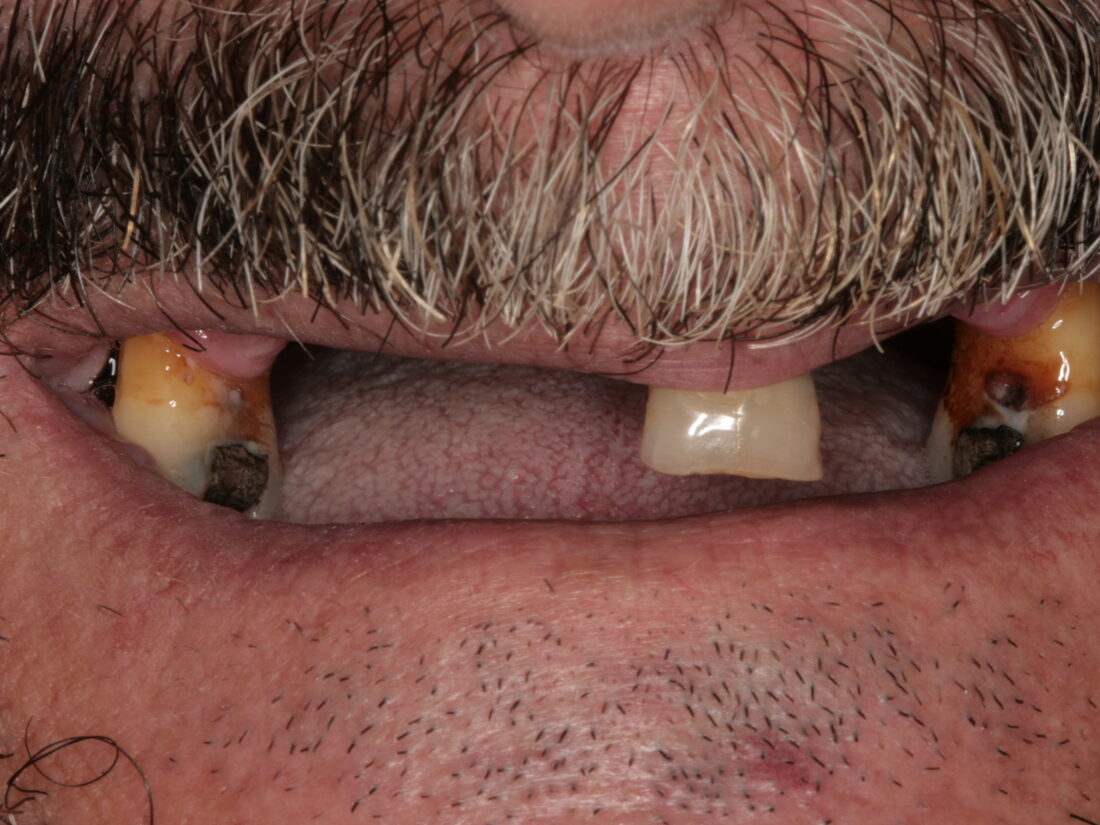
One arch, rebuilt on six implants
An actual patient of Dr. Aguilar, before treatment and after the final bridge. Both frames are original: no cropping, no retouching. The mouth is open in the first and closed in the second, so what the slider compares is the arch, not the lips. Results vary by patient.
Is this treatment right for you?
Candidacy depends on clinical evaluation. X-rays or a CBCT scan may be needed before a final plan.
Often a good fit
- Missing most or all teeth in one or both arches
- Currently wearing full or partial dentures and wanting fixed teeth
- Teeth that can no longer be saved due to decay or gum disease
- Good general health and commitment to aftercare
Needs closer evaluation
- Significant bone loss (may need grafting or a different implant configuration)
- Uncontrolled diabetes or conditions that affect healing
- Heavy smoking, which raises implant failure risk
- Untreated gum infection, addressed before implant surgery
What to expect
Every case is planned individually. This is the shape most journeys take; your evaluation confirms the exact timeline.
"I would suggest anyone who needs good dental care to go see Dr. León in Heredia, Costa Rica. He is a fine dentist!"
 Robert Leischner · Patient review
- 01
Remote evaluation
Dr. Aguilar reviews your photos, X-rays or CBCT and prepares a preliminary plan with an itemized estimate.
- 02
First trip: surgery
Implant placement, usually with a provisional set of teeth so you never leave without a smile. Most patients stay 5 to 8 days.
- 03
Healing at home
Implants integrate with your bone over roughly 3 to 6 months while you follow a simple care routine.
- 04
Second trip: final bridge
The definitive bridge is crafted by the on-site lab, fitted and adjusted, typically over 7 to 10 days.
- 05
Follow-up
Remote check-ins with the clinic team, plus guidance for your dentist at home.
One number, agreed before you fly
- All-inclusive
- Hotel for you and one companion
- Two trips, one price
- One arch
- $13,500
- Both arches
- $24,900
In the U.S. $20,000 to $35,000
In the U.S. $35,000 to $65,000 for the pair
U.S. figures: U.S. full-arch implant costs, Dental Roundup, 2026
Treating both arches together costs less than two single arches, because the trip and the surgical time are planned only once.
What the price covers
- Six German-made Ritter implants per arch, placed by Dr. Aguilar
- The definitive bridge in solid zirconia, not acrylic, from the laboratory in the same building
- Sedation with an anaesthesiologist, plus any extractions and grafting your case needs
- A fixed provisional set the same week, so you never leave without teeth
- 15 nights of four-star hotel across both trips, for you and one companion
- Airport pickup and all local transport
- A bilingual coordinator, from first email to final fitting
What it does not cover
- Medication, about $150
- A sinus lift, only if your scan shows you need one, about $900
The estimate you approve before you fly is the price you pay. If the exam changes the plan, you approve the new number first, or you walk away having paid nothing.
Request Free EvaluationAttach recent X-rays or smile photos to your request and Dr. Aguilar confirms this number for your case, in writing, before you book anything.
Common questions
How many trips to Costa Rica does All-on-6 take?
Most cases take two trips: one for implant placement with a provisional bridge, and a second trip after 3 to 6 months of healing for the final bridge. Single-visit alternatives exist for select cases, confirmed at evaluation.
How long does each trip take?
Plan for 5 to 8 days on the surgical trip and 7 to 10 days for the final restoration trip, so the on-site lab can fit and adjust your bridge properly.
How much can I save compared with U.S. prices?
Patients typically save up to 60% compared with equivalent full-arch treatment in the United States. You receive an itemized estimate after your remote evaluation, before booking anything.
What is the final bridge made of, and why does that change the price?
The definitive bridge is solid zirconia, milled in the clinic’s on-site laboratory. Lower quotes you may find, here or in the United States, are often an acrylic hybrid on a metal bar: it costs less to make, but it wears, stains and chips sooner. When two full-arch prices differ by thousands, the material is usually the reason, so it is worth asking any clinic to put it in writing.
What implant brand do you use?
Ritter Implants, made in Germany and cleared by the U.S. FDA under 510(k) numbers K160475 and K180183, which you can look up yourself in the FDA device database. It is worth asking any clinic to name its system in writing: the brand decides whether a replacement component is still available in ten years, and the lowest full-arch quotes often rest on systems with no U.S. clearance behind them.
Is All-on-6 painful?
Surgery is performed under local anesthesia with sedation options, and most patients manage post-operative discomfort with common medication for a few days. Recovery experience varies by patient.
What if I do not have enough bone?
Bone volume is measured on a CBCT scan during evaluation. Options may include grafting, angled implant placement or a different configuration. The final approach requires clinical diagnosis.
Request your free dental evaluation
Send your information, photos or X-rays, and receive a preliminary recommendation from the treating doctor before you travel.
Content on this page is educational. Treatment depends on clinical evaluation, and results vary by patient.